

Every founder seems to be talking about hiring a VA these days. Platforms like Upwork, Fiverr, and other marketplaces make the process look simple. Just browse a list of profiles, pick someone with a good hourly rate, hand them a to-do list, and expect your workload to shrink. However, e-commerce demands a more specialized approach.
E-commerce moves incredibly fast. Customer expectations shift constantly. Supplier timelines change weekly. Paid media performance rises and falls daily. Inventory, operations, customer experience (CX), and marketing all influence one another. You manage a high volume, judgment-heavy environment where context matters as much as execution.
Traditional VA models were built for simple admin work. E-commerce requires something deeper. This is why founders who want real leverage do not just hire a virtual assistant. Instead, they build virtual assistant systems. These systems are operated by high-level virtual professionals who truly understand the e-commerce tool stack, communication rhythm, and operational pressure.
This blog article discusses the best virtual assistant systems for founders building e-commerce brands today.
Why E-commerce Founders Need VA Systems, Not Just a VA
The typical VA model works fine for coaches, consultants, real estate teams, and other businesses where tasks are linear and predictable. E-commerce is the complete opposite. It requires faster decisions, clearer communication, and stronger technical literacy across tools.
Therefore, it is more accurate to refer to remote hires as virtual professionals, not virtual assistants.
Virtual professionals do more than help with tasks. They run entire systems. They see patterns. They communicate with absolute clarity. They confidently use tools like Shopify, Gorgias, Klaviyo, 3PL portals, Asana, and Sheets. Most importantly, they understand the real operating environment because they have experience inside it. Ultimately, they help founders shift from managing endless tasks to managing clear outcomes.
To understand how this looks in practice, you need to see the six systems they operate.
Core VA Systems That Work for E-commerce Teams
These six systems form the operational backbone of any healthy e-commerce business. They evolve as your company grows, and they also help determine whether you should hire an offshore, onshore, or hybrid team. These systems make up the best virtual assistant systems for founders who prioritize clarity, consistency, and scale.
System 1: Internal and External Communications
Inbox Control, Scheduling, and Founder Enablement

What this system does
It centralizes communication, manages inbox triage, drafts replies, organizes follow ups, prepares meetings, maintains schedules, and protects the founder’s decision making energy.
Roles in this system
• Executive Assistant
• Operations Assistant
• Chief of Staff lite
• Administrative Coordinator
How this system evolves by stage
• Prelaunch: Light inbox cleanup and calendar setup
• Launch: Inbox and scheduling control
• Early Growth: Full triage, meeting prep, follow up systems
• Scale Up: Cross team communication, reporting loops, structured workflows
System 2: Vendor and Operations Coordination
Focus: Supply Chain Management and Logistics Oversight
What this system does
It manages supplier communication, PO tracking, shipping timelines, restock cycles, QC updates, 3PL coordination, and daily operations.
Roles in this system
• Operations Coordinator
• Supply Chain Assistant
• Logistics Analyst
• Purchasing and Inventory Assistant
How this system evolves by stage
• Prelaunch: Supplier research and sample management
• Launch: Basic vendor coordination
• Early Growth: Restocks, timelines, routine supplier updates
• Scale Up: Multi vendor operations, SOPs, dashboards, 3PL oversight
System 3: CX and Customer Support
Focus: Ticket Resolution, Escalation Handling, and Retention Insights

What this system does
It handles refunds, replacements, escalations, ticket queues, routing, proactive retention touch points, and insights that shape product and operations.
Roles in this system
• CX Associate
• Customer Support Specialist
• Escalations Support
• Retention Coordinator
How this system evolves by stage
• Prelaunch: Simple email support
• Launch: Refunds and basic ticket management
• Early Growth: Multi channel CX, macros, weekly reporting
• Scale Up: Subscription ops, VIP flows, advanced retention
System 4: Growth Marketing and Acquisition
Focus: Campaign Execution, Content Workflow, and Performance Reporting
What this system does
It supports content workflows, ad ops, marketplace updates, influencer coordination, email and CRM execution, reporting, and weekly marketing rhythms.
Roles in this system
• Marketing Assistant
• Paid Media Coordinator
• Marketplace Operator
• Content Assistant
• CRM Support
How this system evolves by stage
• Prelaunch: Content scheduling and light research
• Launch: Marketplace updates and campaign support
• Early Growth: Performance tracking, influencer workflows, listing optimization
• Scale Up: Multi channel campaign management, dashboards, broader coordination
System 5: Finance and Accounting
Focus: Bookkeeping, Expense Tracking, and Monthly Financial Closes

What this system does
It organizes bookkeeping, reconciliations, AP/AR, expense tracking, subscription audits, and monthly reporting.
Roles in this system
• Bookkeeper
• Finance Assistant
• AP/AR Coordinator
• Expense and Payroll Support
How this system evolves by stage
• Prelaunch: Simple expense tracking
• Launch: Vendor payments and basic bookkeeping
• Early Growth: Monthly reconciliations, cash flow
• Scale Up: Consolidated dashboards and monthly closes
System 6: People Ops
Focus: Hiring, Onboarding, Documentation, and Culture Support
What this system does
It manages hiring coordination, screening, onboarding, SOP creation, documentation, internal communication, and culture support.
Roles in this system
• People Ops Assistant
• Talent Coordinator
• Onboarding Specialist
• Documentation Support
How this system evolves by stage
• Prelaunch: Light documentation and scheduling
• Launch: Basic onboarding
• Early Growth: Structured SOP creation and performance tracking
• Scale Up: Hiring pipelines, culture assets, internal communication systems
The Six VA Systems: A Quick Recap
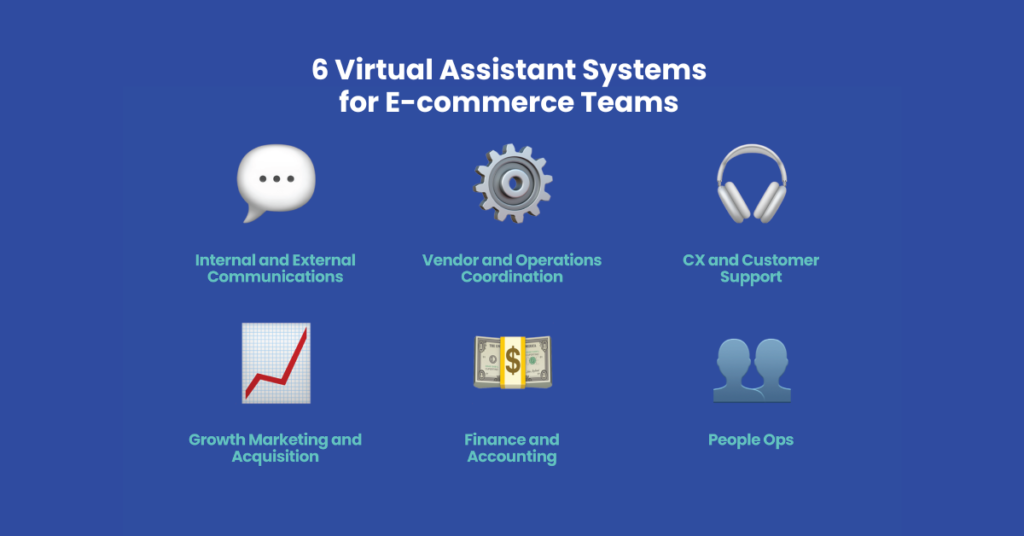
To achieve maximum leverage, founders must install operational structures, not just hire for tasks. The best virtual assistant systems for founders provide comprehensive coverage across the entire e-commerce pipeline. These six interconnected systems—ranging from Internal Communications (managing the founder’s time) and Vendor Operations (managing the supply chain) to CX/Customer Support (handling customers) and Growth Marketing (executing campaigns)—ensure all critical functions are covered. Finally, systems for Finance/Accounting and People Ops provide the necessary foundation for structured, long-term scalability.
Hire for Capability, Not Cost, to Scale Your E-commerce Brand
Many founders make the simple mistake of hiring based on the lowest hourly rate. However, e-commerce roles often require five, ten, or even fifteen years of experience. Professionals with that much expertise will not be in the lowest price bracket.
Junior talent can shine in some parts of the business. Nevertheless, e-commerce is inherently unforgiving. A lack of judgment inevitably leads to:
- More mistakes.
- More escalation.
- More oversight.
- More founder involvement.
- More hidden costs.
Therefore, the real leverage comes from capability, not cost. Hiring the right virtual professional unlocks more time, ensures better execution, and creates a calmer operating environment. Cutting costs too aggressively will only lead to rework and slow down your growth.
Final Thoughts: How More Staffing Builds Systems That Support Growth
VAs are an incredible way to buy back time, but every industry has a different operating model. If you are in e-commerce, the smartest path forward is to think in systems, not tasks. Build VA systems that match your growth stage and staff them with virtual professionals who understand the pressure and pace of ecommerce.
That is where the leverage comes from: The capability, not the hourly rate.
At More Staffing, we vet high-level virtual professionals and design hiring strategies around your growth stage. We match you with operators who can manage real e-commerce complexity. Our roots are in e-commerce operations, so we know exactly which roles help brands scale without chaos. If you want to explore the best virtual assistant systems for founders, book a strategy call and see what the right virtual professional can unlock for your brand.
Want More Insights?
If you want a deeper look at how experienced operators think about scaling, efficiency, and team design, check out this full discussion with ecom thought leader Andrew Faris and More Staffing cofounders Lara Guevara and Gregg Carey. It covers real world lessons, common mistakes, and practical strategies you can apply immediately.