

Remote work has reshaped how companies operate. Founders now build teams across cities, countries, and time zones with unprecedented speed and flexibility.
But as distributed teams scale, many leaders are running into a quieter challenge that does not always show up in dashboards or weekly reports:
Remote work loneliness.
Loneliness is a structural byproduct of remote work itself, and it affects teams at every level of performance. In More Staffing’s Workforce Sustainability Study, isolation and loneliness emerged as one of the most commonly reported challenges among remote professionals.
The nature of remote, distributed work brings real advantages. Greater flexibility. Access to global talent. Fewer geographic constraints. More autonomy in how work gets done. These are meaningful gains for both companies and workers.
At the same time, remote work reduces informal interaction, shared physical context, and spontaneous collaboration. Long stretches of independent execution can gradually create a sense of disconnection, even in otherwise healthy and productive teams.
The good news is that remote work loneliness is predictable, manageable, and solvable when companies treat it as an infrastructure consideration rather than a personal shortcoming.
Remote work loneliness happens even in high performing teams
Time for some myth busting. One common misconception about loneliness in remote teams is that it only affects disengaged or underperforming employees.
In reality, some of the most productive remote professionals experience isolation quietly. Top performers may excel technically and consistently deliver strong results, yet still lack meaningful social connection in their day to day work.
Remote work naturally removes many of the informal interactions that create a sense of belonging. Casual conversations. Shared physical context. The small, unplanned moments that reinforce identity as part of a team. When most communication becomes task driven, social reinforcement does not happen automatically. It has to be intentionally designed.
Remote work also looks different depending on the company and the personal environment of the professional. Some remote workers benefit from supportive home setups, nearby family, or access to local community spaces. Others may work more independently, live alone, or operate in schedules that limit social overlap. Each situation creates a different experience of connection.
Regardless of setup, distributed work reduces everyday human proximity. Over time, that structural distance can contribute to isolation unless companies proactively build systems that maintain connection.
What effective remote support infrastructure is (and what it is not)
Most founders are not blind to the challenge of remote work loneliness. Many already introduce check ins, virtual coffees, or occasional team calls with good intentions. In some cases, these efforts are helpful. In others, they can feel forced, inconsistent, or add to meeting fatigue.
Just as operations rely on SOPs, human connection in remote teams requires intentional systems. Without structure, social interaction depends on individual personalities, manager habits, or temporary bursts of enthusiasm. When workloads increase or personal circumstances become more demanding, these efforts are often the first to chip off.
Effective remote support is about designing infrastructure that supports connection over time. Companies that do this well do not rely on a single initiative. They build layered systems that address different needs as teams grow and mature.
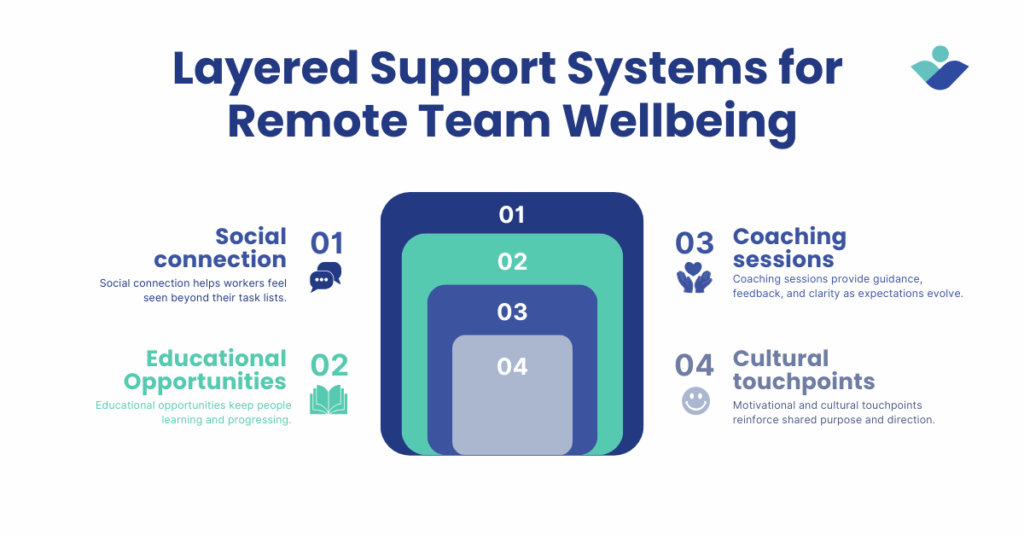
- Social connection helps workers feel seen beyond their task lists.
- Educational opportunities keep people learning and progressing.
- Coaching sessions provide guidance, feedback, and clarity as expectations evolve.
- Motivational and cultural touchpoints reinforce shared purpose and direction.
These elements are meant to complement autonomy and flexibility, not replace them.
When designed properly, support systems are opt-in, lightweight, and respectful of focus. They give remote workers access to connection without demanding constant participation or draining energy.
This approach also allows companies to support different cohorts differently. New hires, senior specialists, and long tenured operators do not benefit from the same type or intensity of engagement. Good infrastructure adapts to that reality.
How companies can support remote teams without forcing culture or over managing

While there is growing awareness around remote work loneliness, founders often raise a second concern: overreach.
Remote workers value independence. Too much forced interaction can feel intrusive, performative, or disconnected from how people actually work.
The real question is how to strike a healthy balance that benefits the individual, the team, and the company’s long-term performance.
Effective support is available rather than mandatory. It is structured, genuine, and not overwhelming. Based on insights from More Staffing’s Workforce Sustainability Study, several approaches stood out as both practical and sustainable:
Health and wellness
One practical area is health and wellness support. Companies provide access to local wellness centers, fitness stipends, or protected time each week for wellness activities such as movement classes or mindfulness sessions. Beyond the benefit itself, these programs create natural opportunities for healthier conversations about energy, stress, and sustainability without singling anyone out.
Professional coaching
Coaching is another meaningful layer when done properly. Coaching is a professional discipline, not an informal check-in that anyone can run. Qualified coaches are trained to listen, guide, and challenge in a way that helps individuals process pressure, clarify goals, and build resilience. For remote professionals, access to structured coaching provides a neutral space for reflection that does not sit inside performance management or daily operations.
Annual or semestral in-person team activities
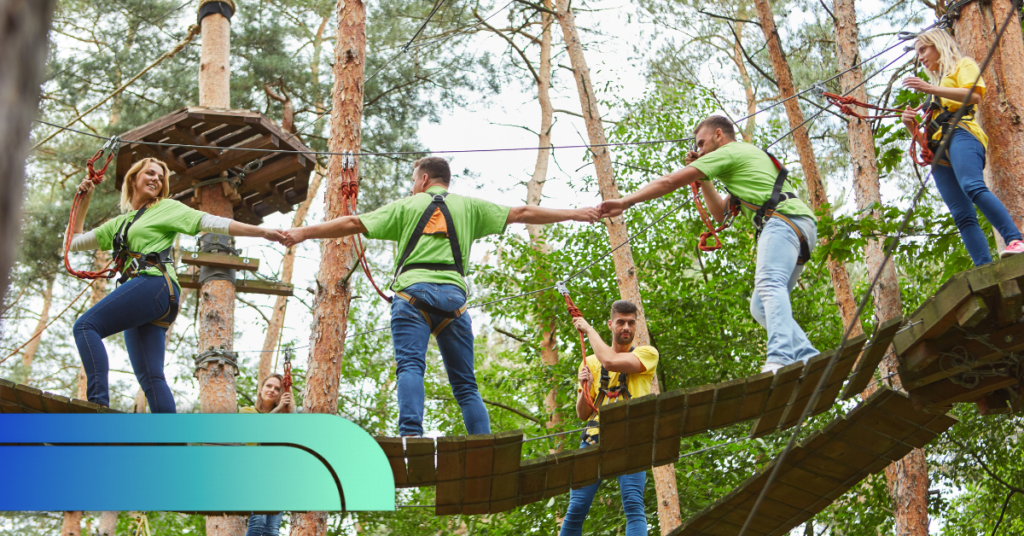
In-person connection also plays a role when it is intentional. Annual or bi-annual meetups give teams a chance to build shared memory and trust. The most effective gatherings are not centered on presentations or status updates. They focus on skill sharing, having plain fun, and time spent in environments that encourage presence, such as nature-based settings or offsite retreats designed for reflection and collaboration.
Education opportunities
Another pillar is ongoing education. Learning creates momentum and purpose, especially in remote environments where growth can otherwise feel abstract. Supporting courses, certifications, or structured learning paths signals long term investment in the individual. Over time, this builds a culture of curiosity, capability, and shared progress.
As a result, when companies invest in these forms of social, educational, coaching, and motivational infrastructure, they create conditions where remote workers can stay connected without sacrificing flexibility or autonomy.
As teams grow, the difference becomes clearer. The absence of support shows up quietly through disengagement and turnover. Well designed support infrastructure compounds in the opposite direction, strengthening performance, loyalty, and long term sustainability.
Final Thoughts
Remote work loneliness is not a failure of individuals or a flaw in remote work itself. It is a predictable outcome of distributed work environments where spontaneous, in person interaction is naturally reduced.
Founders who recognize this early are better positioned to build teams that remain engaged, resilient, and effective over time. In fact, the companies that perform best long term are not the ones that dismiss loneliness, but the ones that account for it in how they design their teams.
That support does not require constant interaction or forced culture. It can take many forms. Health and wellness programs that encourage sustainable routines. Access to professional coaching that supports clarity and resilience. Intentional in person moments that build shared memory. Ongoing education that reinforces growth and long term investment.
Remote work works best when execution and human support evolve together.
At More Staffing, our work goes beyond talent placement. We support companies through onboarding, workflow design, coaching access, and ongoing team development, with flexibility to tailor support based on team size, role complexity, and growth stage.
If you are looking to build a remote team that performs well and stays healthy over time, start with a conversation. Reach out to explore what sustainable remote support can look like for your business.