

Key Takeaways
➜ Successful hiring starts with cultural understanding. Filipino remote professionals often bring strong family motivation, community mindedness, resilience, and respect for hierarchy. Leaders who understand these dynamics can build trust faster and avoid misreading silence, agreement, or overcommitment.
➜ Choose a hiring model that matches your internal capacity. DIY hiring, boutique firms, managed recruitment, and BPOs offer different levels of cost, speed, support, and management responsibility. The right option depends on how much hiring and people management your team can handle.
➜ Define the role beyond the task list. Clear outcomes, decision making authority, and expectations for the first 30, 60, and 90 days help remote talent work with greater confidence and ownership.
➜ Design the working relationship from day one. Time zone overlap, contracts, payroll, confidentiality, communication expectations, and escalation paths should be agreed upon before work begins.
➜ Treat onboarding as a structured operating process. The first 30 to 90 days should include documented workflows, business context, clear ownership, recorded training, and frequent check-ins.
➜ Retention depends on what happens after the hire. Recognition, honest feedback, team connection, professional growth, and visibility into business outcomes help Filipino remote talent feel like long term partners rather than task based support.
The art of hiring Filipino remote talent successfully requires shifting from a transactional, task-based framework to a relationship-driven partnership. Strong English proficiency and technical skill of Filipino remote professionals bring real cost advantages, but the infrastructure built around family- and community-oriented values is what supports long-term retention. Executives who pair cultural alignment with structured tactical support build loyal, high-performing extensions of their local teams.
This guide breaks down both halves: the culture that shapes how Filipino professionals show up at work, and the systems that turn a good hire into a lasting one.
Hiring Filipino remote talent works best when you build for more than task completion. The goal is a working relationship grounded in clear expectations, cultural understanding, and long-term trust.
Understanding the Culture that Filipino Remote Talent is Rooted In
What separates the art of hiring Filipino remote talent from plain hiring? The former builds in cultural fluency, trust, and a genuine sense of partnership from the start. The latter leans on a more transactional process, one focused on filling a seat rather than building a relationship.
While dozens of unique local customs exist, three highly salient cultural drivers dictate exactly how these remote team members will engage with your US operations:
Family Centrism and Collective Motivation
Family is often the primary driver behind a Filipino professional’s career decisions. Gregg Carey, More Staffing’s CEO, ties this to “family being a centerpiece in Filipino culture.” A role serves as a way to support parents, siblings, and children, sometimes across multiple households, and as Gregg points out, that compensation rarely stays with just the immediate household, it often extends to the wider family circle as well. This is part of what explains long-term commitment: stability, predictable income, and a sense of purpose connected to something larger than personal ambition.
Leaders who understand this build in small, deliberate gestures, like flexibility during a family emergency or clear communication about job security during slow periods. These gestures cost little, but they can go a long way in building trust and long term commitment.
Resilience and Bayanihan
Bayanihan, the Filipino concept of communal unity and mutual support, shows up constantly in remote teams. Filipino professionals often help each other through workload spikes, cover shifts without being asked, and problem-solve collectively, a resilience built over decades of economic instability, natural disasters, and infrastructural deficits. Leaders should recognize that support, while also watching for overcommitment. Dependable employees should not become the default person carrying every extra task.
Authority Distance and the “Yes-Man” Trap
Filipino professionals often have a strong respect for hierarchy. That can make it uncomfortable to disagree openly with a manager, even when they have valid concerns. Silence does not always mean alignment. Make honest input easier through one on one check ins, written feedback, or a simple question like, What would you change about this plan? As trust grows, people become more comfortable speaking up.
Understanding these cultural dynamics is only the first half of the hiring equation. The next step is building the practical systems that help Filipino remote talent perform confidently, integrate smoothly, and stay for the long term.
Related: Hiring Remote Workers in the Philippines: A Step-by-Step Guide
Tactic #1: Target the Right Sourcing Pathway
Matching your hiring velocity, budget, and internal management capacity to the correct pipeline prevents two failure modes: overpaying for infrastructure you do not need, or under-investing in structure you cannot live without.
- DIY hiring: Posting directly on job boards. This path offers the lowest financial cost but demands the highest internal time investment, carrying a heavy risk of prolonged vetting cycles.
- Boutique matchmaking firms: Smaller, curated pools with a hands-on introduction process, for founders who still want to fully manage the work relationship themselves.
- Managed recruitment firms: Broader pools, structured vetting, and ongoing support after placement.
- Managed BPOs: Full operational infrastructure, workflows, and oversight layered on top of the talent itself, suited to founders who want to install a function.
The better question is how much operational leverage you actually need, and how much management burden you are willing to carry yourself. You can discover more about the key differences between offshore staffing, outsourcing, and freelancing in our detailed breakdown.
Tactic #2: Define the Role Behind the Task List
A checklist explains what to do. Context explains why it matters, and that difference determines whether an employee can make a good call when a situation falls outside the checklist. Before a role goes live, write down the outcome it’s responsible for, what decisions the person is authorized to make without escalation, and what good looks like at 30, 60, and 90 days. Share all three before the first day.
Tactic #3: Align Time Zones with Intentional Scheduling
Managing the 12 to 15 hour time difference between the US and the Philippines requires intentional design. Decades of a robust BPO industry mean the Filipino talent pool is highly adaptable to night shifts, early mornings, and rotating schedules. Success comes down to absolute clarity about expectations from day one.
Some models that you may consider: The first one is a strict core shift with full overlap, best for real-time roles like support or sales. Second is the hybrid anchor, a few guaranteed overlap hours plus async work, suited to content and support roles. And the third one is core windows with grace periods, for senior roles where output matters more than logged hours. Whichever model you choose, clearly communicate it.
Tactic #4: Establish Legal and Compliance Guardrails
Navigating international compliance does not have to be complicated, but it does require a clear plan from day one to protect your intellectual property and ensure smooth payroll. You can onboard talent as direct independent contractors using standard IRS W-8BEN forms, or you can utilize a global Employer of Record (EOR). Taking a quick moment upfront to secure a clear written contract that explicitly covers confidentiality, IP assignment, and agreed-upon notice periods creates a safe, professional environment where both your US management team and your new remote colleagues can thrive with peace of mind.
Tactic #5: Build a Comprehensive Onboarding Process
The first 30-90 days determine whether a hire becomes a long-term team member. Gregg recommends intentionally “choreographing” this window rather than leaving new hires to simply absorb it as they go, starting from a clean slate and applying an 80/20 approach: spend the first few weeks on the core procedures that make up the “lion’s share” of the role’s day-to-day responsibilities.
Go beyond account access: give a documented overview of the business, a clear map of who to go to for what, recorded walkthroughs of recurring processes, and a check-in cadence that’s heavier upfront. Strong onboarding answers the question before it comes up.
Tactic #6: Give People More than a Slack Login
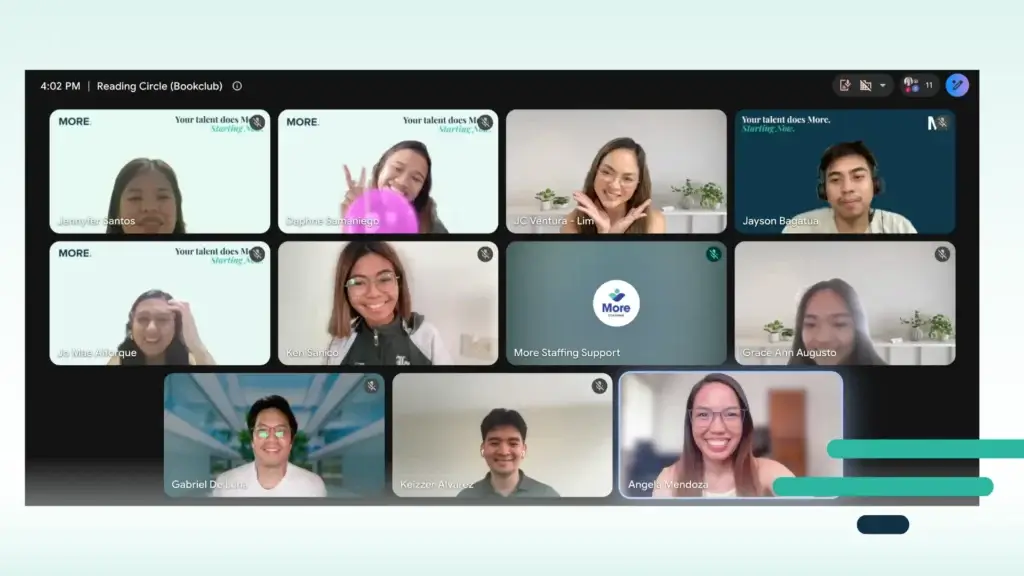
Photo | The More Staffing team’s virtual book club, discussing the book Unreasonable Hospitality.
Remember: remote does not have to mean distant. Founders set the tone for how connected a distributed team feels. A group becomes a team when people have reasons to interact outside of task handoffs: a weekly virtual happy hour with a small food and drink budget, a rotating book club, a skill-sharing session where team members teach each other something outside their role, or simple, consistent birthday and milestone recognition. Pick two or three that fit your team’s size and rhythm, and run them consistently.
Tactic #7: Use What You Know About Filipino Work Culture
Go back to the cultural traits covered earlier in this guide. Filipino professionals often bring deep family values, a strong sense of bayanihan, and sometimes a tendency to fall into the yes-man trap. You do not need to overhaul your management style or become a cultural expert overnight. Just use what you know. Check that your most dependable people are not quietly carrying half the team. Recognize the employees who help others succeed. Bonus points for thoughtful gestures, offer a halo-halo treat on a hot day or send a sincere message checking in on them and their family. Small signals can go a long way in showing that the relationship matters beyond the task list.
Hiring Filipino Remote Talent for the Long-Term
Hiring Filipino remote talent well means treating culture and infrastructure as both important. The founders who get this right build in flexibility, structured channels for honest feedback, a sourcing pathway that matches their real capacity, and systems that make the schedule, the role, and the compliance work clear from day one.
What keeps a hire past the 90-day mark is what happens after onboarding: genuine recognition tied to specific contributions, visibility into how the work connects to company outcomes, and real growth paths. Filipino remote talent, like any talent pool, responds to being treated as a long-term partner. That is the return on getting the art of the hire right.
Related Resources
Ready to Hire Remote Filipino Talent?
Build your team with pre-vetted Filipino professionals who are matched for skills, communication, and long-term fit. More Staffing supports the hiring process from recruitment through onboarding and retention.